
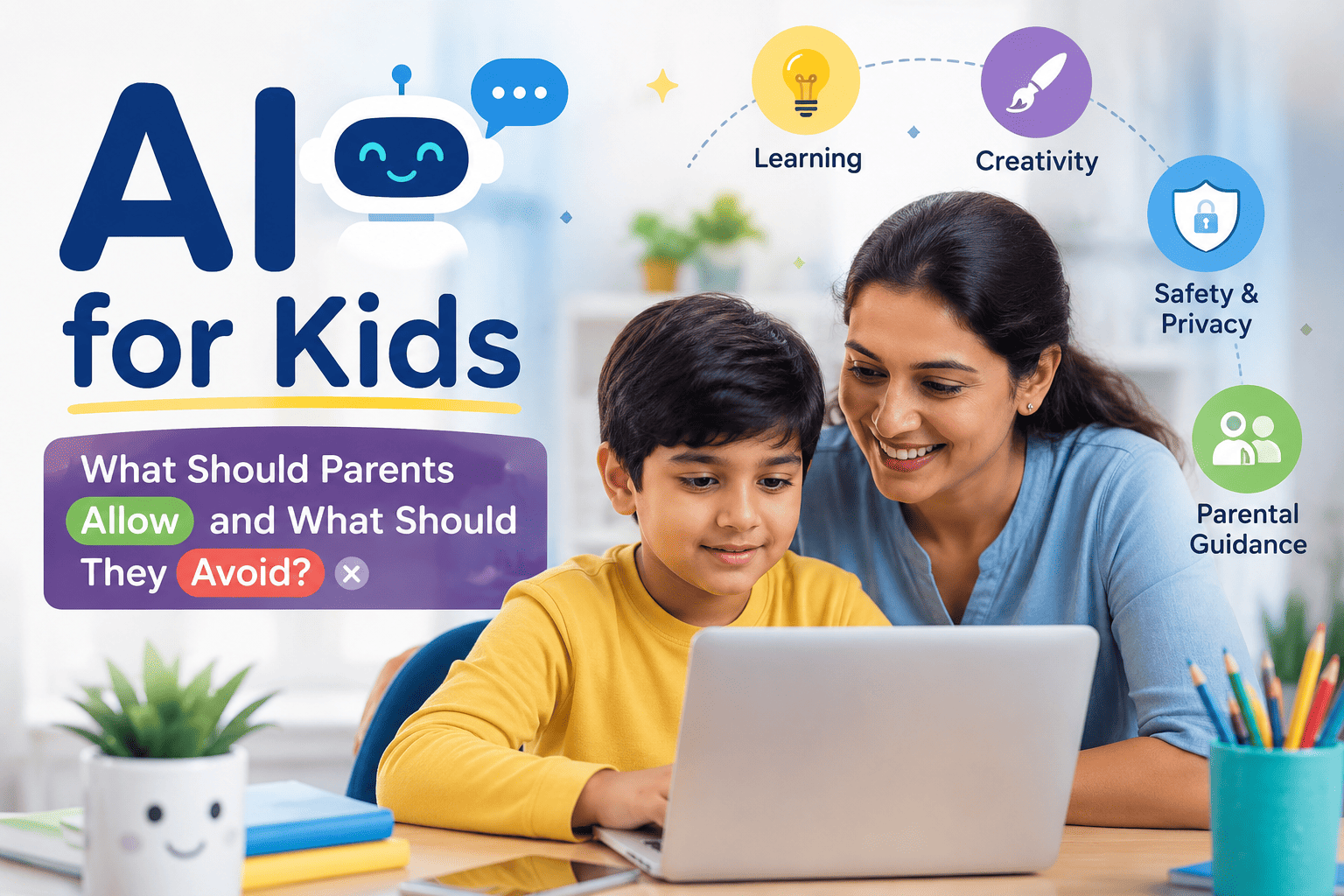
“Can my child use AI?”
It is a question more parents are asking as artificial intelligence becomes part of everyday life.
Children are already encountering AI through search engines, educational apps, games, voice assistants, recommendation systems and increasingly through generative AI tools. At the same time, parents are hearing two very different messages: AI will transform education and AI could negatively affect the way children learn.
So, what should parents actually do?
Should AI be completely restricted?
Should children be encouraged to use it?
Or is there a better middle ground?
The answer is neither complete avoidance nor unlimited access.
Children need guidance, boundaries and opportunities to understand AI as a tool—not as a replacement for their own thinking.
In India, this conversation is becoming increasingly important. NCERT’s Central Institute of Educational Technology has been conducting dedicated programmes to help parents understand AI’s role in children’s learning, while also highlighting concerns around privacy, misinformation, bias, overdependence and responsible use.
So, let’s look at what parents should allow, what they should avoid and, most importantly, what children need to learn about AI.
What Is AI for Kids?
Artificial intelligence may sound complicated, but children already interact with AI in many ordinary situations.
When a child asks a voice assistant a question, receives recommendations on a video platform, uses an AI-powered learning application or interacts with a chatbot, they may be interacting with systems that use artificial intelligence.
Generative AI tools can go further by creating:
Stories
Images
Explanations
Questions
Ideas
Summaries
Games
Creative content
This creates exciting learning possibilities.
But it also creates a new challenge for parents:
If AI can provide an answer instantly, will children still learn how to find, question and understand the answer themselves?
That is where parental guidance becomes important.
What Should Parents Allow?
1. Allow AI-Assisted Exploration
Children are naturally curious.
They ask questions like:
“Why is the sky blue?”
“How do birds fly?”
“What would happen if dinosaurs were still alive?”
AI can sometimes become another way for children to explore questions and discover ideas.
Parents can use AI as a starting point for conversations.
Instead of simply allowing the child to ask AI and move on, try asking:
“What did you learn?”
“Do you think that answer is correct?”
“What else would you like to know?”
This turns AI from an answer machine into a conversation starter.
2. Allow Creative Experiments
AI can be used to encourage creativity when the child remains actively involved.
For example, a parent could help a child create a story idea involving:
A talking tree
A space adventure
A magical animal
An underwater city
A robot visiting Earth
But don’t ask AI to create everything.
Instead, let the child contribute characters, ideas, drawings, dialogue and endings.
The important distinction is:
AI can support creativity. It should not replace creativity.
Children should still have opportunities to imagine, draw, write, build, act and create without technology.
3. Allow AI to Explain Difficult Ideas
One useful application of AI is explaining a difficult concept in a simpler way.
For example, if a child doesn’t understand a science concept, AI may provide another explanation or analogy.
But parents should encourage children to compare that explanation with their textbook, teacher or trusted educational resources.
Why?
Because AI can produce information that sounds convincing even when it is incomplete, inaccurate or misleading.
NCERT specifically highlights the importance of helping parents and children understand issues such as information quality, bias and verification when using AI.
So teach children:
“AI can help explain something. It doesn’t automatically mean the answer is correct.”
4. Allow Parents and Children to Explore AI Together
For younger children especially, AI use should not become an isolated activity.
Instead of giving a child unrestricted access, parents can explore appropriate AI experiences together.
Ask:
“What did you ask?”
“Why did you ask that?”
“What answer did it give?”
“Do you agree with it?”
“Where else can we check?”
This creates something more valuable than technical knowledge.
It builds AI awareness and critical thinking.
5. Allow AI to Become a Question Generator
One interesting way to use AI is to generate questions rather than answers.
For example, after reading a story, a parent could use an appropriate AI tool to generate questions about the story.
Then the child answers them independently.
This changes the role of AI.
Instead of:
AI → Answer → Child
it becomes:
AI → Question → Child thinks → Child answers
That is a much healthier learning pattern.
What Should Parents Avoid?
1. Don’t Let AI Do Your Child’s Homework
This is perhaps the most important rule.
If a child has a writing assignment, project or homework task, using AI to generate the entire answer defeats the purpose of the activity.
The child may submit a polished response without understanding it.
Instead, AI can potentially be used for:
Brainstorming ideas
Generating questions
Finding different ways to approach a problem
Explaining a difficult concept
But the child should still think, write, solve and explain independently.
The goal of education isn’t simply to produce the correct answer.
It is to develop the ability to reach the answer.
2. Avoid Treating AI as an Always-Correct Teacher
AI can sound extremely confident.
That can make incorrect information difficult for children to identify.
Teach children an important habit:
“Check before you trust.”
For important information, encourage them to compare the response with:
Their textbook
Their teacher
Trusted educational websites
Library resources
Reliable reference material
The ability to question information will become increasingly important as AI-generated content becomes more common.
3. Don’t Share Personal Information
Children should never casually enter personal information into AI tools.
Parents should teach children not to share information such as:
Full name
Home address
Phone number
Passwords
School details
Personal photographs
Family financial information
Private conversations
Other sensitive information
Privacy should become part of a child’s digital education.
NCERT’s AI-parenting guidance specifically identifies privacy and responsible digital behaviour as important areas for parents to understand.
A simple rule for children is:
“If you wouldn’t tell a stranger, don’t type it into an AI tool.”
4. Avoid Using AI as a Substitute for Human Interaction
This is particularly important for younger children.
AI can talk.
AI can answer questions.
AI can create stories.
But children still need real conversations with:
Parents
Teachers
Friends
Siblings
Grandparents
Other children
Children develop communication and social skills through real-world interaction.
A chatbot cannot replace playing with another child, negotiating during a game, telling a story to a parent or standing in front of a group and expressing an idea.
Technology should support childhood—not replace it.
5. Don’t Allow Unlimited AI Screen Time
AI can make screen use feel educational.
But “educational” does not automatically mean “unlimited.”
Children still need time for:
Play + movement + conversation + reading + creativity + outdoor experiences + rest + technology
A balanced routine is more important than simply counting whether screen time is “productive.”
Parents should look at what the child is doing with technology, how long they are using it and what activities are being replaced.
6. Avoid Letting Children Become Dependent on AI
Imagine a child who asks AI every time they encounter a problem.
They don’t know an answer?
Ask AI.
They can’t think of a story?
Ask AI.
They don’t know how to solve something?
Ask AI.
They don’t know what to draw?
Ask AI.
Over time, this can discourage independent problem-solving.
Instead, introduce a simple rule:
Think First. Ask Second.
Give children a chance to form their own answer before turning to AI.
Ask:
“What do you think?”
That question may become more important than the AI answer itself.
The Biggest Skill Children Need in an AI World
It isn’t knowing how to use the latest AI tool.
It is knowing when to question the tool.
A child who can ask:
“Is this true?”
“How do we know?”
“Could there be another answer?”
“Where did this information come from?”
“Why should I trust it?”
is developing a skill that will remain valuable even as technology changes.
This is why critical thinking matters.
AI can generate information.
Children need to learn how to evaluate it.
AI Should Not Replace Creativity
Imagine two children are asked to create a story.
Child A asks AI:
“Write me a story about a lion.”
They copy the response.
Child B starts with:
“I want a lion who is afraid of the dark.”
Then they create a character, decide what happens, change the ending and perhaps use AI to generate a few ideas.
Both children used AI.
But only one remained the creator.
This distinction matters.
Children should continue to:
Draw
Paint
Build
Sing
Dance
Act
Tell stories
Invent games
Ask questions
Make things with their hands
These experiences help develop imagination and expression.
Technology should give children more ways to create, not fewer reasons to create.
A Simple AI Rulebook for Parents
Parents don’t need a complicated technology policy at home.
Start with a few simple rules.
Rule 1: Think before asking AI
Give your child a chance to solve the problem independently.
Rule 2: Never blindly trust an AI answer
Check important information.
Rule 3: Don’t share private information
Teach children that personal data should be protected.
Rule 4: AI can help, but it shouldn’t do the work
The child should remain actively involved.
Rule 5: Keep real-world experiences first
Play, conversation, creativity and physical activity still matter.
Rule 6: Use AI together when possible
Especially with younger children, parents should guide exploration.
Rule 7: Ask questions about the answer
Don’t stop at “What did AI say?”
Ask:
“What do you think?”
What Parents Should Teach Children About AI
Rather than teaching children to fear artificial intelligence, parents can teach them five simple ideas:
AI is a tool.
It can help us explore and create.
AI can make mistakes.
Not everything it says is necessarily true.
AI doesn’t think like a human.
It generates responses based on patterns and information rather than having human experiences and understanding.
AI needs responsible users.
People decide how technology is used.
Human skills still matter.
Creativity, empathy, communication, curiosity, collaboration and critical thinking cannot simply be outsourced.
These principles are increasingly relevant as education systems begin preparing students for an AI-enabled future. CBSE’s planned computational thinking and AI-related curriculum for Classes III–VIII from the 2026–27 academic session is one example of this shift in Indian education.
What About Preschool Children?
For preschoolers, the conversation should be different.
A four-year-old doesn’t need to become an AI expert.
At this stage, children benefit enormously from activities such as:
Storytelling
Pretend play
Drawing
Music
Movement
Conversation
Group games
Hands-on activities
Exploring nature
Building and creating
These experiences help children develop communication, confidence, creativity and social interaction.
If technology is introduced, it should remain age-appropriate, limited and guided by adults.
For young children, real-world learning should remain at the centre of their experience.
The Future Isn’t About Humans vs AI
Parents sometimes ask:
“Will AI replace the skills my child is learning today?”
A better question may be:
“What human skills will become even more valuable because AI exists?”
Think about communication.
AI can generate a speech.
But a child still needs the confidence to stand in front of people and deliver it.
AI can create a story.
But a child still needs imagination to develop an original idea.
AI can answer a question.
But a child still needs curiosity to ask a better question.
AI can generate an image.
But a child still needs creativity to imagine what they want to see.
AI can provide information.
But a child still needs critical thinking to decide what to believe.
That is why the future of education isn’t simply about teaching children how to use technology.
It is about helping them become confident, curious and thoughtful people who know how to use technology responsibly.
Final Thoughts: Guide, Don’t Just Restrict
AI is not going away.
Trying to completely hide children from every form of artificial intelligence may not prepare them for the world they will eventually enter.
But unrestricted access isn’t the answer either.
The better approach is guided exposure.
Let children explore.
Let them ask questions.
Let them experiment creatively.
But also teach them to pause, think, question, verify and protect their privacy.
Most importantly, make sure technology never takes away the experiences children need most:
playing with others, communicating face-to-face, imagining, creating, solving problems and discovering the world around them.
The goal isn’t to raise children who know how to use every AI tool.
The goal is to raise children who know when to use AI—and when to put it away and think for themselves.
Frequently Asked Questions
Is AI safe for kids?
AI can provide useful learning and creative opportunities, but children need age-appropriate tools, adult guidance and clear boundaries. Parents should pay particular attention to privacy, inappropriate content, misinformation and overdependence.
At what age should children start using AI?
There is no single age that applies to every child or every AI tool. Parents should consider the child’s age, maturity, the tool’s age requirements and the purpose of use. Younger children generally benefit more from guided, shared experiences than independent AI use.
How can children use AI for learning?
AI can potentially help children brainstorm ideas, explore questions, receive explanations and practise concepts. However, children should remain actively involved in thinking, solving and creating rather than simply copying AI-generated answers.
Can AI replace teachers?
AI can provide explanations, suggestions and interactive learning experiences, but it cannot replace the relationships, judgement, encouragement and human interaction provided by teachers.
Should parents completely stop children from using AI?
Complete avoidance may not be practical as AI becomes increasingly integrated into education and everyday technology. A better approach is to establish appropriate boundaries and teach children responsible, critical and safe use.
How can parents teach children responsible AI use?
Start with simple rules: protect personal information, verify important information, think before asking AI, don’t use AI to do all the work, and talk openly about how AI-generated information should be evaluated.
